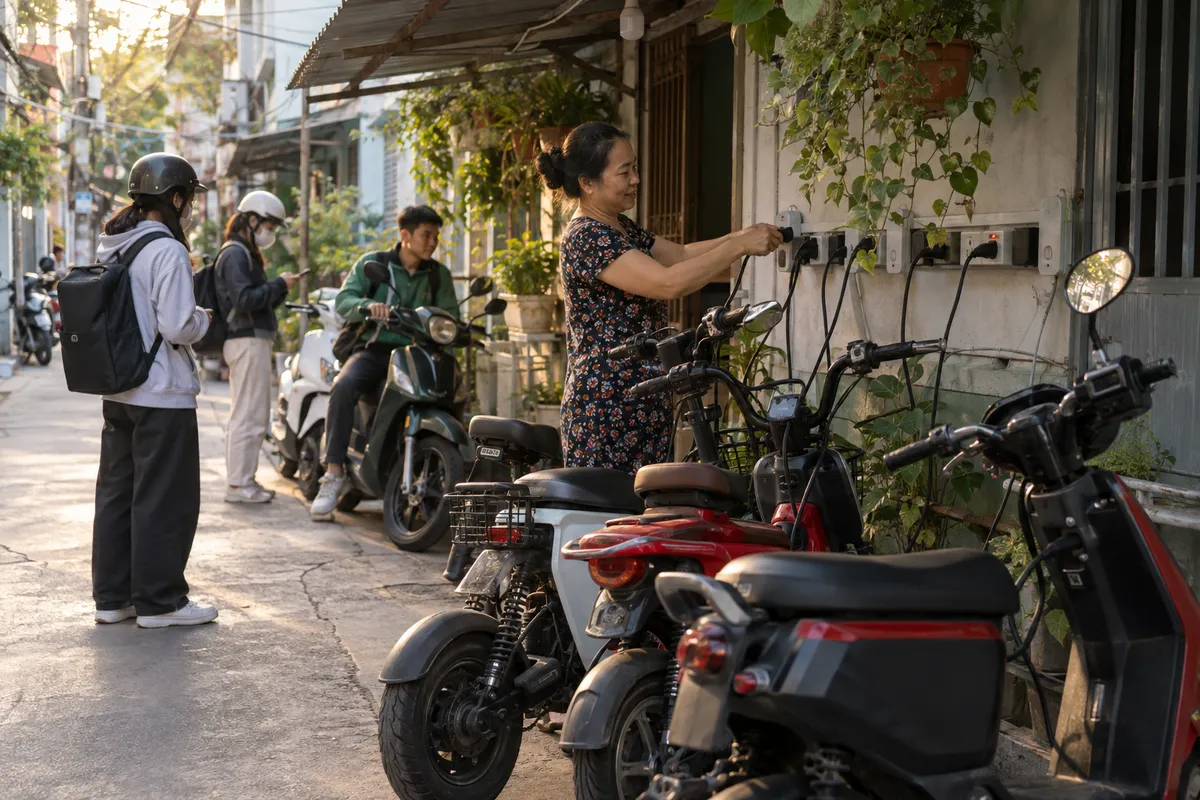
Public charging networks usually get the headlines when people talk about EV adoption. A short video from The New York Times points to something messier and more interesting in Vietnam: homeowners turning their own properties into informal charging hubs as riders move from gas motorbikes to electric two-wheelers.
By the end of this piece, you'll understand how that charging economy works at a high level, why fuel shocks speed it up, and what it suggests about EV adoption anywhere charging is thin on the ground.
What's happening in Vietnam
Per the New York Times, the war in Iran has brought on a rapid switch from motorbikes to electric two-wheelers in Vietnam. That shift has created an informal charging economy led by entrepreneurial homeowners.
The key detail is who is building the infrastructure. It isn't only utilities or big operators. Ordinary people with a bit of space and a power connection are stepping in to serve riders who need a place to charge.
The Times' report, as summarized, doesn't give us pricing, number of hubs, or sales figures, so we won't guess at them here. What we can lay out is the shape of the story and what it implies.
Why fuel shocks speed up e-bike adoption
The logic is simple. When conflict creates fuel pressure and energy uncertainty, the cost and reliability of gasoline become daily concerns. Consumers look for cheaper, more flexible ways to get around, and a two-wheeler is already the practical vehicle for many urban riders.
Switching from a gas motorbike to an electric one changes the problem from "where do I find fuel" to "where do I plug in." That second question is exactly where the homeowners come in.
My take: this is why two-wheelers may be the quiet frontier of EV adoption. A small battery needs far less charging infrastructure than a car, which lowers the barrier for someone with a spare outlet to become a service provider.
The home charging shop as a side hustle
The appeal of the model is that it grows from the bottom up. A homeowner who sees neighbors and passing riders needing power can offer a place to charge, and a side business appears without waiting for a government rollout or a corporate network.
That makes the infrastructure flexible. It shows up where demand is, in the neighborhoods where riders live and work, rather than where a planner decided it should go.
If you follow EV news, it's a useful reminder that "charging infrastructure" isn't one thing. It can be:
- Large, planned networks built top-down
- Small, local setups built by people who spot a need
Vietnam's surge, according to the Times, leans heavily on the second kind.
What it says about the future of cities
The story suggests climate tech adoption doesn't always arrive through a polished national plan. Sometimes it spreads because everyday people solve a local problem faster than formal systems can.
For dense cities where two-wheelers dominate, that has real implications. Charging can be distributed across homes and storefronts instead of concentrated in a few stations. Whether that approach scales safely and reliably is a fair question the short video summary doesn't answer, and it's worth watching how it develops.
What you can take from it
You don't need to live in Vietnam for this to matter to your own view of EVs:
- Watch two-wheelers, not just cars. Smaller electric vehicles can move faster when fuel gets expensive or uncertain.
- Treat charging as a local economy. Where official networks lag, informal ones can fill the gap.
- Expect crises to reshape habits. Energy shocks push buyers toward alternatives quickly, as the Times reports in Vietnam's case.
The bottom line
If you want to gauge where EV adoption is really heading, look at who is plugging in vehicles and where. In Vietnam, per the New York Times, the answer includes homeowners with an outlet and an eye for opportunity. Keep an eye on that kind of grassroots charging, because it may show up in other places before the big networks do.