
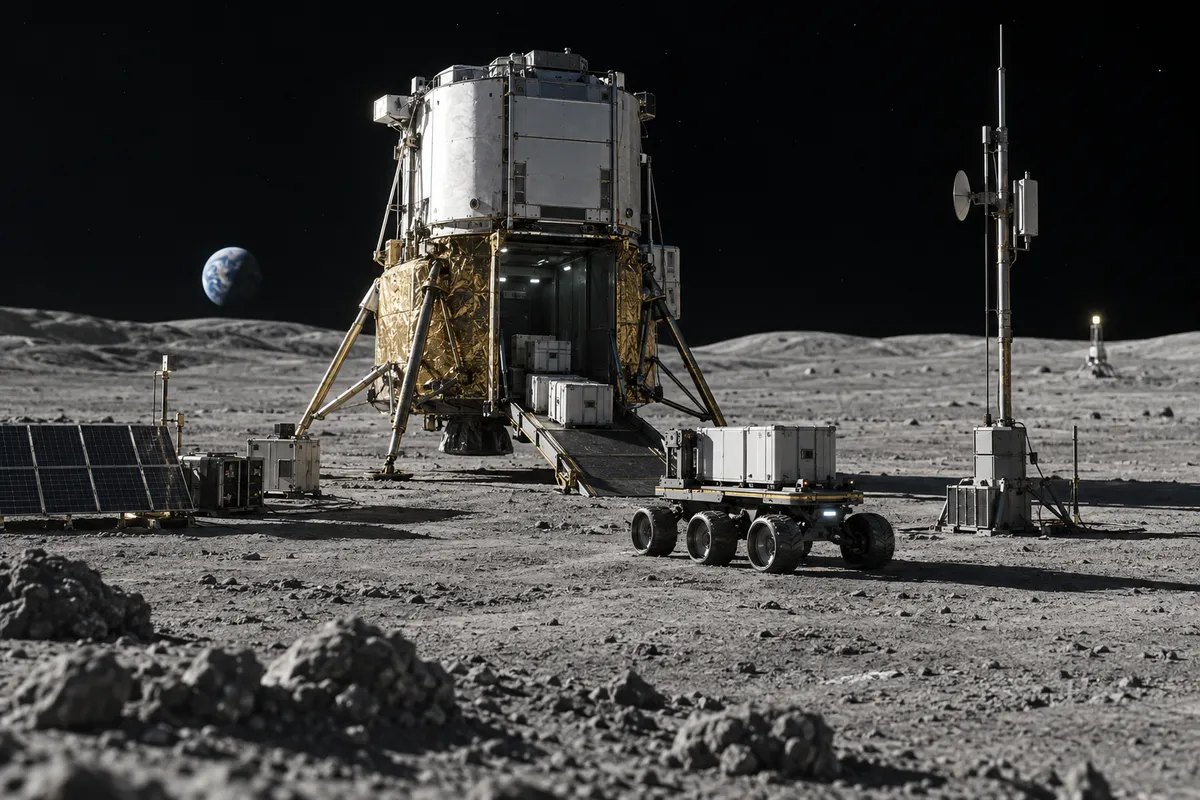
NASA is putting roughly $20 billion into a Moon Base, and the most interesting part isn't the price tag. It's the shape of the spending. According to Autoevolution, the agency has detailed a spread of missions across CLPS, CLPS 2, VADR missions and lunar infrastructure components, all meant to support the Artemis Moon Base. Read together, they describe less a single government project and more a commercial supply chain.
If you follow the auto and mobility industry, that framing will feel familiar. Here's how to read it.
The Big Shift: From One-Off Missions to Logistics
Per Autoevolution's reporting, NASA is moving away from isolated Moon missions toward an industrial-scale lunar logistics network, with major contracts running through the 2030s. The agency is building a private-sector supply chain covering:
- Landers
- Cargo delivery
- Navigation
- Communications
- Power
That's the same playbook any automaker or fleet operator knows: you don't build a business on one trip, you build it on repeatable delivery. A base can't be sustained by a handful of heroic launches. It needs a steady flow of hardware, and NASA is buying that flow from companies rather than doing it all itself.
CLPS vs. VADR: Two Ways to Buy Lunar Delivery
The programs named in the report are CLPS, CLPS 2 and VADR missions. The source material we have doesn't spell out the finer contract terms, so we won't guess at them. What it does make clear is the strategy: NASA is stacking multiple commercial buying channels so that landings arrive as a steady stream instead of a rare event.
The headline in Autoevolution's piece points the same way, describing an avalanche of commercial landings incoming. That's the practical takeaway. More providers and more contracts means more chances to deliver payloads, and less dependence on any single vehicle or company.
Why Infrastructure Matters More Than Landers
Landers get the attention, but a base is more than a place to touch down. The report highlights lunar infrastructure components, including navigation, communications and power. Think of it like the EV world: a great car means little without chargers, maps and connectivity. A Moon Base without power and comms is just a parked vehicle.
This is also where the commercial approach could pay off. Infrastructure that several customers can use is exactly what private companies are good at scaling, though how well that plays out on the Moon remains to be seen.
The Moon as a Proving Ground for Mars
Autoevolution's piece ties the spending to future Mars-readiness. The logic is straightforward: the Moon is close enough to test systems, supply routines and operations before anyone commits to something farther away. Our read is that this is the real reason to care about the logistics side. Landing once proves a rocket works. Resupplying a site repeatedly proves a system works.
What to Watch
This is an early-stage picture, and timelines are long. A few things will tell you whether the strategy is working:
- Cadence: Do commercial landings actually arrive as often as the plan implies?
- Infrastructure follow-through: Do navigation, comms and power components land alongside cargo?
- Competition: Does a wider field of commercial providers emerge as Artemis timelines and space competition intensify?
The report notes that Artemis timelines, commercial competition and Mars ambitions are all intensifying at once, which raises the stakes for each of those questions.
The Takeaway
When you see the next lunar contract announcement, don't judge it as a standalone mission. Ask where it fits in the supply chain: delivery, power, navigation or communications. That's how NASA is now organizing the Moon Base, and it's the lens that makes the $20 billion number make sense.